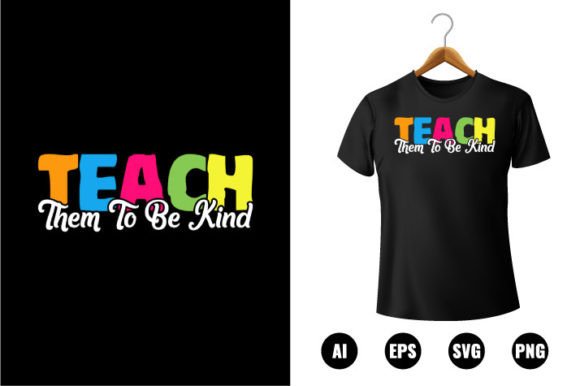
Teach Them to Be Kind T-shirt Design
A Teach Them to Be Kind T-shirt Design isn’t just a visual motif—it’s a deliberate communication tool with tangible strategic utility. Designed for back-to-school season but extending far beyond the classroom calendar, this digital clip art asset delivers measurable value when aligned with clear goals: brand consistency, audience resonance, operational efficiency, and values-driven positioning. Its versatility—spanning clothes printing, engraving, stickers, canvas, scrapbooking, and printable décor—means it functions not as decoration alone, but as infrastructure for thoughtful execution.
Why This Design Fits Real-World Planning Cycles
Back-to-school isn’t only about students and supplies. It’s a high-intent seasonal window where educators, small business owners, nonprofit coordinators, and creative entrepreneurs make decisions that shape engagement for months. A Teach Them to Be Kind T-shirt Design aligns with that timing because kindness is a measurable cultural lever—not abstract sentiment, but a driver of classroom climate, team cohesion, customer trust, and community alignment. When you deploy it intentionally, you’re not selling apparel; you’re anchoring a message in a moment when people are actively investing in growth, structure, and shared values.
This design works best when integrated into a broader plan—not tacked on as an afterthought. For example, a school counselor launching a social-emotional learning initiative can pair the shirt with workshop materials, parent handouts, and hallway posters—all built from the same vector files. That consistency reduces cognitive load for stakeholders and reinforces messaging across touchpoints. Likewise, a boutique gift shop owner can use the same AI and SVG files to produce matching tote bags, enamel pins, and digital newsletter headers—ensuring visual continuity without redundant design labor.
Strategic File Formats Enable Intentional Use
You’ll receive AI, EPS, PNG, and SVG files—each serving distinct operational needs:
- AI and EPS: Essential for professional screen printing, embroidery digitizing, or large-format vinyl cutting. These preserve full vector fidelity and layer integrity, letting you isolate text, icons, or background elements for color adjustments or layout reconfiguration.
- SVG: Ideal for web integration—think e-commerce product previews, interactive lookbooks, or digital signage—where scalability and lightweight rendering matter.
- PNG: Delivers crisp, transparent-background assets for social media graphics, email headers, or print-on-demand mockups—no extra clipping or masking required.
The fact that all files are 300 DPI, Adobe Illustrator CC–compatible, and built with 100% editable vector shapes means you retain full control over size, proportion, color, and composition. No pixelation at poster scale. No licensing surprises. No dependency on third-party fonts or missing links. That level of technical readiness directly supports decision-making speed and production reliability—especially critical when managing tight deadlines like back-to-school launches or fundraising campaigns.
Color Flexibility Is a Strategic Advantage—Not Just a Feature
“100 color changeable” isn’t marketing language—it reflects real workflow leverage. Suppose your school district’s brand palette recently shifted from navy-and-gold to teal-and-charcoal. With this Teach Them to Be Kind T-shirt Design, updating every derivative asset (stickers, banners, digital ads) takes minutes—not hours—because colors are applied to grouped vector objects, not embedded raster layers. That agility supports responsive branding, seasonal promotions (e.g., swapping to pastels for spring wellness events), or inclusive customization (offering high-contrast versions for accessibility compliance).
More importantly, color strategy ties directly to psychological impact. Research shows teal evokes calm and trust; warm yellows signal optimism and approachability. Choosing one palette over another isn’t aesthetic preference alone—it’s a calibrated choice about how you want your audience to feel and act upon seeing the message. That intentionality separates effective use from decorative randomness.
When—and When Not—to Deploy This Design
Use this Teach Them to Be Kind T-shirt Design when:
- You’re building a values-aligned campaign with measurable outcomes—like reducing behavioral referrals by 15% through consistent positive reinforcement visuals;
- Your team lacks in-house design capacity but requires brand-consistent outputs across multiple channels;
- You serve audiences who respond to authenticity over polish—teachers, parents, volunteers—where handmade warmth matters more than corporate gloss;
- You need to scale physical products quickly without compromising quality—say, producing 200 shirts for a staff appreciation day with three-day turnaround.
Avoid deploying it when:
- No clear goal anchors the effort—e.g., ordering shirts “just because it’s back-to-school” without linking them to training, policy rollout, or community dialogue;
- Your audience has signaled fatigue with virtue-signaling visuals and expects deeper action—kindness initiatives backed only by apparel risk appearing performative;
- You haven’t assessed fit with existing systems—e.g., your print vendor doesn’t support AI files, or your website CMS can’t render SVG properly, creating last-minute workarounds.
Long-Term Value Lies in Reusability—Not One-Time Use
This Teach Them to Be Kind T-shirt Design earns its ROI over time, not per transaction. Because it’s fully vector-based and modular, you can repurpose components across years and contexts: extract the heart icon for a gratitude journal cover; convert the typography into a chalkboard-style classroom door sign; adapt the layout for a “Kindness Pledge” certificate template. Each reuse compounds value while minimizing recurring creative cost.
Consider a youth program director who uses the design in Year 1 for camp T-shirts, Year 2 for volunteer recognition badges, and Year 3 for a fundraising campaign banner. The core message remains stable—reinforcing institutional memory—while applications evolve with shifting priorities. That kind of longitudinal coherence builds recognition and credibility in ways one-off designs cannot match.
Operational Discipline Supports Creative Impact
Even the strongest design underperforms without process discipline. Before importing the AI file into your workflow, ask:
- What outcome do we want this to influence? (e.g., increase parent sign-ups for empathy workshops by 20%)
- Which audience segment is most likely to act—and what do they need to see first? (e.g., teachers may respond to classroom-ready PDFs; parents may engage more with Instagram carousels)
- What existing assets can this design replace or upgrade? (e.g., outdated PDF handouts, inconsistent Canva templates)
- Who owns updates—and how will version control be managed? (e.g., naming convention: “Kindness_Tshirt_v2_TEAL_2024”)
Answering those questions transforms the Teach Them to Be Kind T-shirt Design from a static download into a living component of your communication architecture.
Final Consideration: Kindness as Infrastructure, Not Ornament
At its best, this design serves as visible infrastructure for something deeper: intentional culture-building. A T-shirt isn’t kind—but the conversation it sparks, the policy it represents, the behavior it encourages—that’s where real impact lives. So treat the file not as an endpoint, but as a catalyst. Let the clean vectors, editable colors, and scalable formats free up mental bandwidth to focus on what matters most: designing experiences, not just graphics. When kindness is woven into planning, operations, and decision-making—not just printed on cotton—you don’t just wear the message. You live it.