School Bus Driver T-shirt Design: A Versatile Digital Asset for Back-to-School Creativity
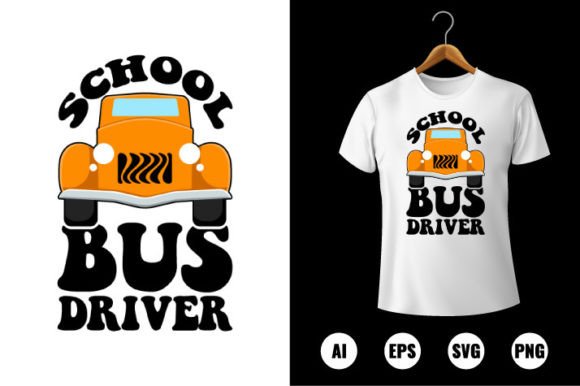
When educators, parents, and transportation professionals prepare for the new academic year, visual identity matters—not just in school branding or classroom decor, but in how individuals express pride, professionalism, and community spirit. The School Bus Driver T-shirt Design stands out as more than a seasonal graphic; it’s a purpose-built digital resource engineered for flexibility, precision, and broad creative reuse. Designed explicitly as a Back to School T-shirt Design, this asset bridges functional utility with expressive intent—serving drivers, schools, PTA groups, small-batch apparel entrepreneurs, and crafters alike.
Why Format Diversity Matters in Practical Use
The inclusion of AI, EPS, PNG, and SVG file formats isn’t merely a technical footnote—it reflects deliberate design thinking for real-world constraints. Each format fulfills a distinct role across production workflows:
- AI (Adobe Illustrator) files provide full layer integrity and native editing capability—ideal for professional designers adjusting typography, repositioning vector elements, or integrating the design into larger brand guidelines.
- EPS ensures backward compatibility with older RIP (Raster Image Processor) systems used in commercial screen printing and large-format vinyl cutting—critical for school district vendors operating legacy equipment.
- PNG delivers high-fidelity transparency and crisp edges at 300 DPI, making it suitable for direct-to-garment (DTG) printing, digital mockups, or web-based storefront previews where vector support is limited.
- SVG enables responsive scaling on websites, interactive e-learning modules, or digital signage—without pixelation—even when resized dynamically across devices.
This multi-format availability eliminates workflow bottlenecks. For example, a school volunteer organizing a “Driver Appreciation Day” can use the PNG version to quickly generate printable posters, while a local print shop owner edits the AI file to adjust stroke weights for optimal screen-print durability on cotton-poly blends.
Print-Ready Precision Meets Real-World Production Needs
The specification “100 Print ready” signals more than quantity—it reflects intentional preflighting. Every file has been validated for color mode (CMYK for process printing, RGB for digital displays), bleed clearance, and embedded fonts or outlined text. There are no hidden raster layers, unlinked assets, or inconsistent path directions that could trigger errors during RIP processing.
At 300 DPI, raster components (such as textured backgrounds or subtle halftone effects within the design) retain clarity even when printed at 12" x 16" on tote bags or canvas banners. Meanwhile, the underlying vector geometry remains infinitely scalable—meaning the same bus illustration that fits neatly on a child’s youth-sized t-shirt can expand cleanly to wrap an entire school van door without distortion or aliasing.
Color Adaptability as a Strategic Advantage
“100 Color Changeable” goes beyond simple hue swapping. It means every shape, gradient stop, and stroke is built using editable swatches—not hardcoded hex values or flattened appearances. Designers can shift the entire palette in seconds: converting a yellow school bus to navy blue for a winter safety campaign, or shifting from primary red accents to high-visibility orange for improved roadside recognition.
This adaptability supports inclusive representation too. A rural district might recolor the driver figure’s uniform to match their actual fleet livery. A bilingual charter school could overlay Spanish-language text (“¡Conducimos con Orgullo!”) using the same editable type layers—no need to request custom revisions from the original designer.
Resizability Without Compromise
Vector-based construction ensures every element—from the bus outline and window panes to the driver’s cap brim and steering wheel—is composed of mathematically defined paths. Unlike bitmap graphics, which degrade when stretched, these shapes maintain sharp corners, smooth curves, and proportional spacing regardless of scale.
This becomes especially valuable in mixed-media applications. A scrapbooker may reduce the bus icon to 0.5" for a journal sticker, while a facilities manager enlarges the same SVG to 48" wide for a hallway safety poster—both outputs render identically crisp because they reference the same vector source. No interpolation, no loss of fidelity, no manual redrawing.
Editing Simplicity Across Skill Levels
“Easy to edit” doesn’t assume expertise—it assumes intentionality in layer naming, grouping logic, and object organization. In the Illustrator file, layers are labeled descriptively (“Bus Body,” “Driver Figure,” “School Name Placeholder”), not cryptically (“Layer 1 Copy 3”). Key elements are grouped meaningfully: windows share one group, wheels another, typography its own—so changing one component rarely affects unrelated parts.
Hobbyists using free tools like Inkscape can open the SVG and modify colors via the fill panel. Educators building classroom resources in Canva can upload the PNG and add custom text boxes directly over the design—no design software required. Even non-designers benefit from the clean separation between foreground illustration and background space, simplifying cut-and-paste integration into newsletters or parent handouts.
Applications Beyond Apparel
While named a School Bus Driver T-shirt Design, its utility extends far beyond fabric:
- Engraving: The vector paths translate cleanly to laser engravers for personalized wooden keychains, acrylic desk plaques, or metal ID tags—ideal for staff recognition programs.
- Stickers & Decals: Die-cut vinyl versions hold up well on water bottles, laptop lids, or bus window decals—especially when exported as SVG with optimized path simplification.
- Canvas & Wall Art: Large-format printers reproduce the design on stretched canvas or mural paper, turning transportation corridors or cafeteria walls into affirming spaces that honor driver contributions.
- Scrapbooking & Printable Decor: Teachers incorporate scaled-down versions into student welcome packets, reading logs, or behavior charts—adding visual consistency to back-to-school routines.
- Digital Learning Tools: Instructional designers embed the SVG into interactive PDFs or LMS modules to illustrate traffic safety concepts, sequencing diagrams, or community helper units.
In each case, the foundational quality—vector integrity, resolution independence, and structured layers—ensures consistent results without requiring specialized technical knowledge.
Design Philosophy Embedded in Technical Execution
This Back to School T-shirt Design embodies a quiet but important shift in digital asset creation: away from static decoration toward modular, future-proof infrastructure. It avoids trendy visual gimmicks (excessive drop shadows, unrealistic textures, or fixed perspective angles) in favor of clean silhouettes, balanced negative space, and typographic openness—making it equally effective on a kindergarten t-shirt and a district-wide safety campaign banner.
The driver figure, for instance, is drawn with neutral posture and minimal facial detail—not to erase individuality, but to invite interpretation. Educators can discuss roles and responsibilities without projecting assumptions about age, gender, or ethnicity. Students can color in the figure themselves, reinforcing engagement through active participation rather than passive consumption.
Implementation Considerations for Different Users
Success with this asset depends less on owning expensive software and more on matching format choice to outcome:
- Small Business Owners: Use the AI file to create branded merchandise bundles—pair the bus design with custom slogans (“Proudly Driven by Ms. Chen”) and export print-ready PDFs for local screen printers.
- PTA Volunteers: Leverage the PNG in free tools like Google Slides to build event flyers, then download as PDF for bulk printing at office supply stores.
- Art Teachers: Import the SVG into classroom tablets or Chromebooks and guide students through basic vector manipulation—changing colors, duplicating elements, or experimenting with composition.
- Fleet Managers: Extract individual components (e.g., the bus silhouette alone) and integrate them into maintenance checklists or driver training decks—reinforcing visual literacy around vehicle identification and safety zones.
No single approach dominates. What unites these varied uses is shared access to a reliable, editable, and context-aware foundation—the hallmark of a truly useful School Bus Driver T-shirt Design.
Long-Term Value Through Reusability
Unlike disposable social media graphics or time-bound templates, this design functions as infrastructure. Its vector nature means it won’t become obsolete with software updates. Its neutral aesthetic avoids dating quickly. Its layered structure supports iterative improvement—adding seasonal elements (fall leaves, snowflakes) or updating school names year after year without redesigning from scratch.
That longevity transforms cost-per-use metrics. A $29 purchase may yield dozens of distinct outputs across multiple school years—supporting orientation events, safety weeks, appreciation days, and emergency preparedness drills—all anchored by the same trusted visual core.
Ultimately, the School Bus Driver T-shirt Design succeeds not because it shouts, but because it listens—to the needs of makers, the constraints of production, and the quiet dignity of those who keep students moving safely between home and learning.