Kids Book Mockup: Realistic Back-to-School Visuals
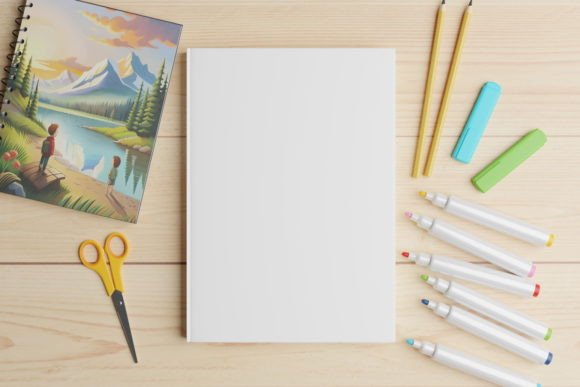
Imagine a clean, inviting image: a crisp white-covered children’s book resting on a sunlit wooden table, surrounded by gentle school-themed props—colored pencils, a small chalkboard, a stack of lined notebooks, and a pair of round-rimmed glasses. That’s the Kids Book Mockup: a ready-to-use visual template designed to showcase your original children’s book cover with realism and warmth. It’s not just a placeholder—it’s a storytelling tool that helps your idea land before a single page is read.
What Is a Kids Book Mockup—Really?
A Kids Book Mockup is a high-resolution digital file (provided here in EPS, JPEG, and PNG formats) that simulates how a physical children’s book would look in a real-world setting. Unlike flat cover art, this mockup includes natural shadows, subtle texture, lighting direction, and contextual objects—all carefully composed to evoke curiosity, learning, and playfulness. You don’t need 3D software or photography skills. Just drop your cover design onto the designated smart layer (in Photoshop) or use it as an overlay in Canva, Figma, or even PowerPoint—and instantly communicate tone, age-appropriateness, and educational intent.
Why It Matters—Depending on Who You Are
Different people reach for a Kids Book Mockup for different reasons—not because they all want the same thing, but because they’re solving distinct problems with shared constraints: time, clarity, and credibility.
For Educators & Curriculum Designers
You’re preparing a back-to-school newsletter, planning a literacy unit, or pitching a classroom resource to your school board. A polished, relatable image helps parents and administrators *see* how your material fits into daily learning. Using this mockup with a custom cover showing phonics practice or social-emotional themes makes abstract concepts tangible—without needing a photo shoot or budget approval.
For Indie Authors & Self-Publishers
You’ve written a rhyming story about kindness—or a STEM-themed picture book about backyard bugs. When listing on Amazon KDP, sharing on Instagram, or sending a pitch to a local library, first impressions hinge on visuals. This mockup gives your book presence. It signals professionalism without requiring a $500 photoshoot. And because it’s available in EPS (vector), you can scale it cleanly for print brochures or large-format displays at a school fair.
For Graphic Designers & Freelancers
Your client—a small publishing house or a parent launching their first book—needs fast, flexible deliverables. You value files that open reliably across platforms, support non-destructive editing, and adapt to multiple uses: web banners, email headers, printed catalogs. The layered PSD version (if included separately) lets you adjust lighting or swap props; the PNG offers quick drag-and-drop use; the EPS ensures sharpness in any layout program. Speed matters—but so does consistency across touchpoints.
For Small Business Owners & Gift Shops
You sell handmade bookmarks, story kits, or subscription boxes for early readers. Pairing your product with a realistic Kids Book Mockup helps customers imagine how your item complements real books kids love. You might place your bookmark design subtly on the mockup’s open page, or show your box beside the book and pencils—creating lifestyle context that plain text or stock photos rarely achieve.
How Priorities Shift Across Experience Levels
Beginners often ask: “Will this work in Canva?” or “Do I need Photoshop?” The answer is yes—and also no. The JPEG and PNG versions require no editing software at all. Upload them directly to social posts, blog headers, or Etsy listings. If you’re just starting out, ease of use and immediate results matter most. You’re not optimizing for print resolution yet—you’re building confidence and testing messaging.
More experienced users focus on flexibility and longevity. They check whether the shadow angles match their brand’s lighting style, whether the background texture reads well on dark mode, or if the object arrangement feels inclusive (e.g., diverse pencil colors, gender-neutral props). They appreciate that this mockup avoids clichés—no cartoonish clipart, no forced smiles—so it supports authentic, modern children’s publishing values.
For educators using it year after year, reliability and reuse are key. They save the file once, label it clearly (“Back-to-School Book Cover Template”), and pull it up each August to refresh newsletters or staff handouts. No licensing worries. No attribution required. Just quiet utility—like a well-worn lesson plan binder.
Practical Uses Beyond Back-to-School
While the scene evokes fresh notebooks and backpacks, its usefulness stretches across seasons and goals:
- Spring literacy campaigns—swap in a floral border or pastel palette behind the same mockup.
- Library summer reading programs—add a “Read Together” badge over the cover.
- Teacher training workshops—use it to demonstrate how cover design influences student engagement.
- Author website portfolios—showcase multiple book concepts side-by-side, all anchored by the same trusted visual frame.
It works because it’s neutral enough to adapt—but specific enough to feel intentional.
Does This Fit Your Next Step?
Ask yourself:
- Is your goal to communicate quickly? Yes—if you need a trustworthy visual for a pitch, post, or proposal within the next hour.
- Do you value consistency over customization? Yes—if swapping one cover design into a repeatable, professional frame saves more time than building from scratch each time.
- Are you balancing creativity with practical limits? Yes—if you care about quality but don’t have access to studio lighting, models, or advanced design tools.
This Kids Book Mockup won’t replace editorial feedback, developmental editing, or reader testing. But it does remove one friction point between idea and audience—giving your work room to be seen, considered, and chosen.
A Final Note on Authenticity
Great children’s books grow from empathy, observation, and care. So do great visuals that represent them. This mockup doesn’t shout. It invites. It leaves space—for your words, your voice, your child’s imagination. Whether you’re sketching your first draft at the kitchen table or finalizing a print run for a regional bookstore, it’s a quiet ally in making learning visible, joyful, and real.